Showing posts with label The F-Words in Childhood Disability. Show all posts

Friday, 9 January 2026

Webinar: Join Us to Learn a Life-Changing Approach to Wellbeing


There is so much talk about self-care in the online caregiving discourse that it's just plain exhausting. What we need is a simple and realistic way to think about how to meet our own physical and emotional needs while we give care to another. I found a great one and it's called The F-Words in Childhood Disability (but it's not just for children with disabilities, I've used it for myself and it truly changed my life). 

I'm excited to tell you about an upcoming F-Words webinar! Dr. Peter Rosenbaum will join me in conversation about how this approach came to be and how it has helped tens of thousands of families around the world. The webinar is on January 15 at noon EST and you can register for the link HERE. 


I first learned about the F-Words when I heard about this article that my friends Dr. Peter Rosenbaum and Dr. Jan Willem Gorter wrote for a medical journal. The F-Words are: FUNCTION, FAMILY, FITNESS, FUN, FRIENDS AND FUTURE. The F-words build upon the World Health Organization's (WHO's) International Classification of Functioning, Disability and Health (ICF) framework. The ICF framework shows how body structure and function, activity, participation and environmental factors and personal factors are interrelated and equally influence our health and functioning. 

These domains are key ingredients for the health of any child growing up with a disability but I began to think about how we could use this framework for everyone in the family, especially the caregiver! 

Here is the simple F-Words template. You can download and fill it in using images or words (images are helpful is the person you care for has cognitive or visual challenges). Everyone in the family can fill in a personal template and then share the results to see who can help whom reach their goals: 


Think about your own personal goals in each of the F-Word domains. Given the givens, what can you realistically hope for in your own Function, Family, Fitness, Fun, Friends and Future? What are activities or goals that you could add into these domains? Use this template to think about balance in your caregiving life and share it with your loved one, your extended family, friends and even the medical professionals who support you. 

Ask yourself how your family members' F-Word goals mesh with your own. Can you negotiate or use these goals to help create a schedule of activities that reflect your best effort at balance? 

For more information on the F-Words, check out the range of free tools and resources on the CanChild website HERE. And join us for the webinar if you can to learn more about how the F-Words changes caregivers' lives (including my own) for the better! 

Sunday, 23 February 2020

A Cool Tool For Balancing Caregiving With...LIFE


Image result for balance in caregiving

There is so much talk about self-care in the online caregiving discourse that it's just plain exhausting. What we need is a simple and realistic way to think about how to meet our own physical and emotional needs while we give care to another. I think I found a good one and it's called The F-Words in Childhood Disability

I first learned about the F-Words when I heard about an article that my friends Dr. Peter Rosenbaum and Dr. Jan Willem Gorter wrote for a medical journal. The F-Words are: FUNCTION, FAMILY, FITNESS, FUN, FRIENDS AND FUTURE. The F-words build upon the World Health Organization's (WHO's) International Classification of Functioning, Disability and Health (ICF) framework. The ICF framework shows how body structure and function, activity, participation and environmental factors and personal factors are interrelated and equally influence our health and functioning. 

These domains are key ingredients for the health of any child growing up with a disability but I began to think about how we could use this framework for anyone giving or receiving care. 

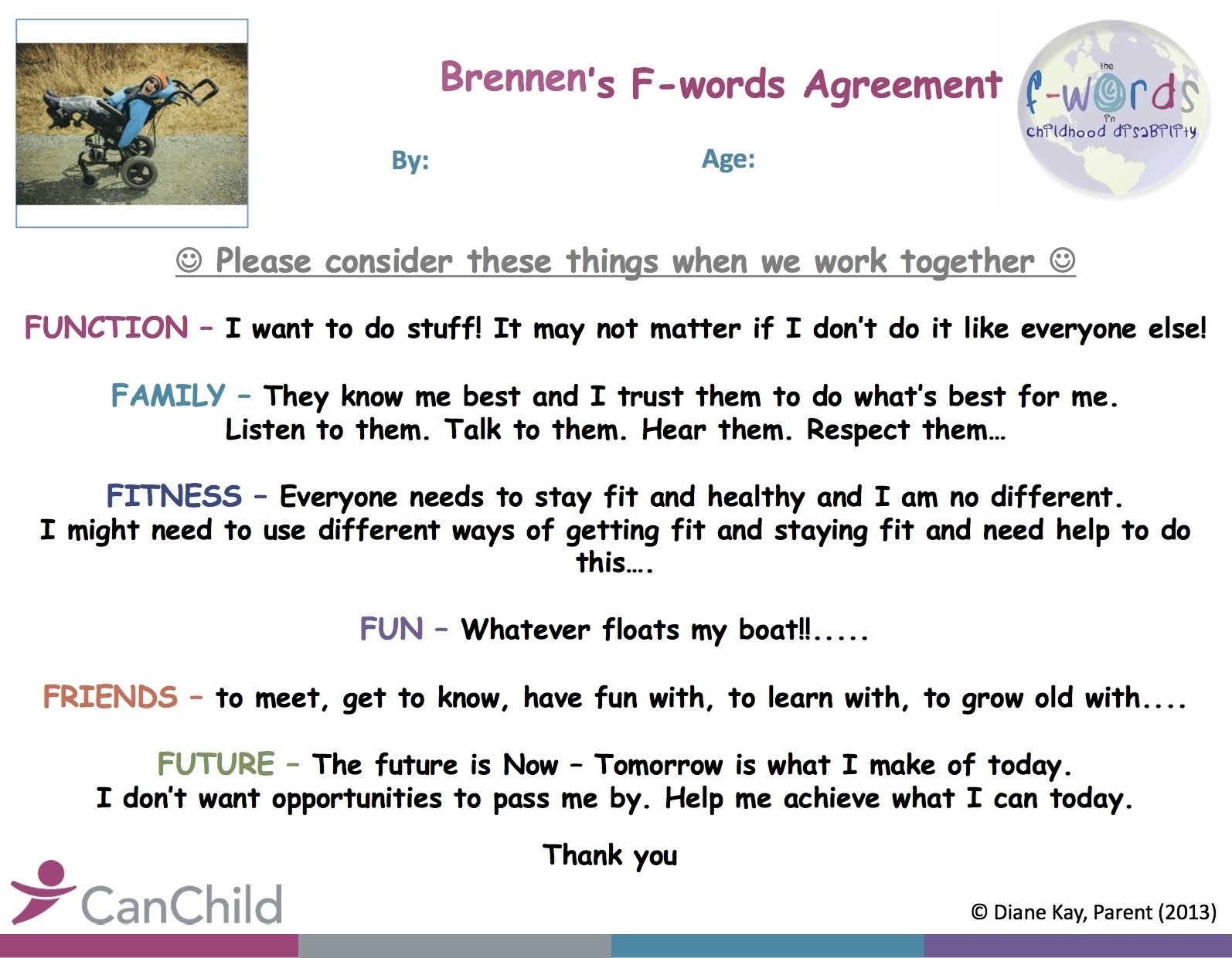
Here's how a young man called Brennan filled in his F-Words template: 


Now imagine how your loved one would fill in his or her F-Words template. Try it with them by downloading a template HERE. Even if your loved one is non-speaking or very incapacitated by illness or disability, they will have goals based on their 'best day' that you could fill in for them.

Now complete one for yourself. Given the givens, what can you realistically hope for in your own Function, Family, Fitness, Fun, Friends and Future? What are activities or goals that you could add into these domains? Use this template to think about balance in your caregiving life and share it with your loved one, your extended family, friends and even the medical professionals who support you. 

Ask yourself how your loved one's F-Word goals mesh with your own. Can you negotiate or use these goals to help create a schedule of activities that reflect your best effort at balance? 

For more information on the F-Words, check out the range of free tools and resources on the CanChild website HERE


Friday, 26 October 2018

What the Heck is Happening? I'm a Caregiver?


Caring for a dependent loved one is a chaotic business. There isn't much time for reflection, let alone laundry and grocery shopping. I'm always thinking, "If we can figure out a framework for planning our days, then maybe life would be a little easier." Some of those frameworks I've talked about before are Amartya Sen's Capability Approach (I used this approach in my book, The Four Walls of My Freedom to analyze what kind of help was helpful in our family) and the F-Words of Disability (a wellbeing framework designed for children with disabilities, but it works for anyone). 

Today I want to introduce an idea that I borrowed from the community development work of Cormac Russell and John McKnight at Nurture Development and the ABCD Institute, respectively. McKnight and Russell talk a lot about enabling marginalized communities to escape cycles of dependency by systematically supporting the sharing and talents and gifts of people in order to address their own challenges within neighbourhoods. The Asset Based Community Development movement developed the 'To, For, With, By' framework as a way of understanding how social services work in ways that are often oppressive. But today, I want to borrow this framework and think about it another way. 

As caregivers, we often do things 'TO' our loved one, especially in the case of cognitive impairment. Sometimes we dress our loved ones even when they don't want to get dressed or we guide them into a bath and shampoo their hair. Certainly in our family, I've given medications and tube feeds while our son didn't miss a beat watching his favourite show on TV. There are many things we need to do TO our loved ones and they need us to do to them. Sometimes these actions are negotiated - our son told me that he doesn't want to be consulted on his medications - he just wants whomever is helping him to get on with doing it 'invisibly'. 

And caregivers spend a lot of time doing things FOR our loved ones. "Here, let me do that for you": that's what we say when we see someone making an effort to reach a magazine or to put on a sock. It's an empathic reaction to assist when asked to help in one way or another. 

Then there are the times we perform chores or engage in activities WITH our loved ones. I loved to arrange flowers with my Mom and I love cooking with our son. I smile when I think of being absorbed in an activity that we enjoy together - these are the delicious moments of caring for someone who is loved. 

The hardest nut to crack though, is BY. In my caring life, what are the activities that I've helped my Mom and our son to do by themselves? How have I managed to help them achieve independence? Can I be doing this more and have I slipped too easily into doing TO and FOR instead of WITH AND BY? I'm going to think this over and seek opportunities to balance these aspects of caring. And I'm going to ask our son if he is happy with the balance. I'll report back on that conversation. 

Tuesday, 16 January 2018

WELLBEING IN CAREGIVING - Here's How to Get It

There are two questions about caring families that interest me. The first is, "How can we plan our days and weeks to give us a better chance of being happy?" The second is, "How can we tell how we're doing with our wellbeing plan?"

If you feel like your life is not your own, that you just get blown and buffeted from crisis to crisis (or one monotonous day just seems like the next), then this blog post's for you. It's time to get intentional about how we live our lives and to do that, we need to think differently about wellbeing. Here are two approaches that can help caregivers influence health and happiness in the family.

1) The Wellness Wheel is a project of Hospice Yukon in Canada. Infused with wisdom of native people in the north, this is a simple way of day planning to ensure your life is balanced between activities of mind, body, spirit and heart.
But how can we use this idea of the self to ensure we nourish all these aspects of the caregiver self? Here's how. Start by choosing just one activity from each domain, every day. See whether there are activities that you can share with your loved one, because they need the benefits of the Wellness Wheel, too.

NOTE: Thank you to the wonderful end of life coach and author Katherine Arnup for the link to this site. If you'd like to know about this approach, read this terrific research paper titled 'The Wellness Wheel: An Aboriginal Contribution to Social Work' by Margot Loiselle, PhD and Lauretta McKenzie, MSW.

The second wellbeing approach I'd like to present is called The F-Words in Childhood Disability.  This strategy for planning daily life to optimize health and happiness may be from CanChild, a pediatric disability research institute at McMaster University in Canada, but the approach works for anyone. I love it.

Here are the F-words. Think about what they might mean in your life and the life of your loved one, no matter their age or circumstances - these are HUMAN concerns.


Function: 
refers to what people do - how things are done is not what is important; synonyms include ‘role’, ‘job’, ‘task’, etc. (for children, ‘play’ is their ‘work’)


Family
: represents the essential ‘environment’ of all children


Fitness: refers to how children stay physically active, including exercise and other recreational opportunities

Fun: includes particular activities children are involved in or enjoy participating in

Friends: refers to the friendships established with peers; social development is an essential aspect of personhood


Future: 
is what child development is all about; it refers to parents and children's expectations and dreams for their future 


Here's how the F-Words work for youth with disabilities, but consider what they might mean for designing the day (and the week) for someone with Alzheimer's or dementia. Think of how these approaches might change your family life and your wellbeing.